


Lawn Care Crew Size: Why the 2-Man vs. 3-Man Debate Has Two Different Answers
A couple of years back, two guys pulled into my driveway to do a turf application.
That's the whole story. One application, two technicians, a job that one person handles every other round of the year. Nobody did anything wrong. The work got done. The front yard and the back yard got split, and the truck pulled away in half the usual time.
It bothered me for a week. So I called Ben Gandy.
Ben is a principal at Envisor Consulting and spent years deploying LEAN across the country's largest landscape providers. I thought it was the perfect scenario to setup for Ben to teach us all a lesson, so we recorded the conversation.
Here's why I'm revisiting it now.
Why every crew size answer you find contradicts the last one
Go search "best lawn care crew size" and you'll get whiplash. One source says one-man crews are the most efficient but you shouldn't build a company on them. Another says two is the magic number. A trade magazine profiles an owner who found three works better at condo complexes. Forum threads stretch back a decade with operators swearing by everything from one to six.
They're not contradicting each other. They're answering different questions.
Lawn care and landscaping are two different businesses, and crew size has two different answers depending on which one you're running. Lawn care - applications, mowing routes, high stop counts, tight geography - is almost always a one-man-in-the-truck operation. Landscape maintenance and enhancements, where crews work a property together for hours at a stretch, is a genuine debate between two, three, and four.
Nearly every article you'll find blends the two and lands on mush. Let's separate them.
The scenario: same man-hours, so where's the waste?
Start with my driveway. One hour of work. Two technicians splitting it into thirty minutes each. Identical man-hours either way.
I put it to Ben as a challenge - tell me why this isn't LEAN. He didn't need the spreadsheet I'd prepared.
His answer came in about ten seconds: mobilization. If each stop runs thirty minutes, an applicator is making somewhere around sixteen stops in a day. Put ten minutes of drive time between each one and that's 160 minutes of travel - and you're paying for it twice, because there are two men in the cab instead of one.
He put it plainly: you don't get to skip the drive. You just pay double for it at every single stop.
The math
Here's the sheet I built.
Six properties in a day. An hour of production work at each. Fifteen minutes of drive time between stops.
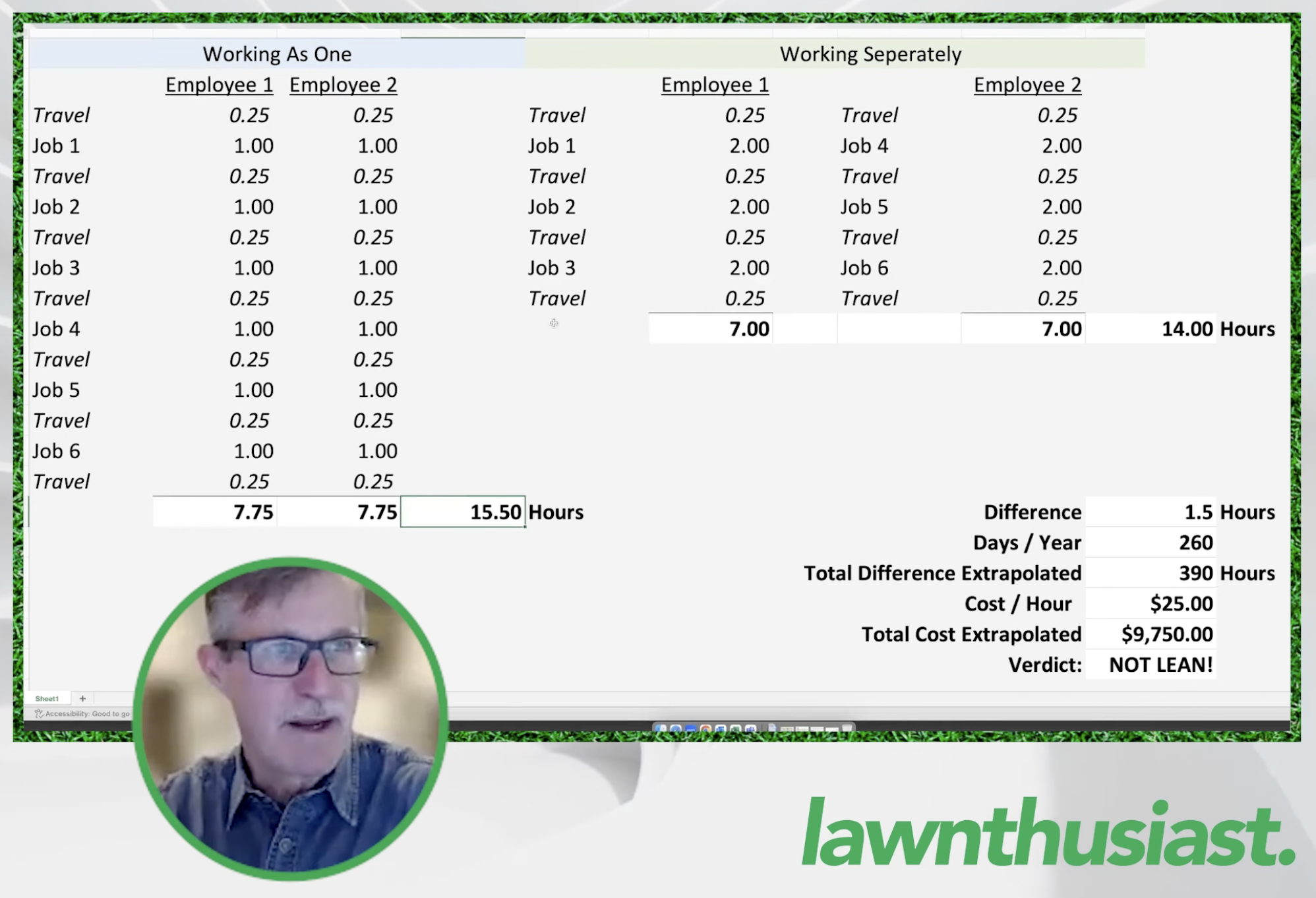
The production hours are identical. That's the part worth sitting with. Nobody worked harder or faster in either column - a job that takes one man two hours takes a pair one hour, so it's twelve man-hours of production either way. The entire difference is six duplicated trips at fifteen minutes apiece. One hour and thirty minutes of paying two men to look out the same windshield.
Notice where those legs actually are. Most owners, when they think about drive time, picture the hops between stops. But the day also starts with a drive and ends with one. That's seven legs on a six-stop route, not five - and the roll-out and the roll-back get doubled right along with everything else. The trips nobody counts are a meaningful share of the waste.
Run it across a working year:
- 1.5 hours per day × 260 days = 390 hours
- 390 hours at a $25/hour average burden = $9,750
Just under ten thousand dollars a year to have two men sit in one cab. No production gained. No customer better served. The verdict cell on my sheet reads NOT LEAN, and Ben didn't argue with it.
The part most owners miss: this isn't a cost problem
Where the conversation turned for me was Ben refusing to stop at the savings.
Take those recovered hours and put them back on the board, he said. Same two men, same trucks rolling, but now each one has room for another stop. You haven't reduced cost - you've added capacity. You're collecting the gross margin on work you weren't able to fit before.
That reframe matters because of the objection every owner raises next: sure, but now I need two trucks, and trucks aren't free.
Ben's response is the sharpest thirty seconds in the video. On labor alone you're already ahead by nearly ten thousand dollars. Add the gross profit from the extra stops each technician can now absorb, and the savings buy the truck. The second vehicle isn't a cost you're absorbing to make the math work. It's a cost the math already covered.
More top-line revenue, more gross profit dollars, marginal increase in cost.
The boulder test: when more people is the right answer
Now the other half, because this is exactly where the internet's crew size advice falls apart.
I raised it with Ben directly. Two guys will move a boulder faster than one guy. There are absolutely jobs where adding bodies creates efficiency instead of destroying it.
That's the test, and it's a simple one: can the work actually be done in parallel?
A turf application can't. There's one hose, one spreader, one pass across the lawn. A second technician doesn't accelerate the work, he divides it - and then rides along for the drive.
Landscape maintenance and enhancements often can. Mulch beds, install work, cleanups, anything on a larger property where multiple people have distinct work in front of them the entire time they're on site. There the production genuinely compounds, the drive time gets amortized across a longer stop, and the crew size conversation becomes a real one.
Ben's verdict on my scenario: sometimes the right number of people is more than one - but in the situation I laid out, the right number of people is one guy in the spray truck.
Applications, generally, are not a two-man job.
The exceptions that are actually fine
I want to state the next part clearly, because rules calcify into dogma fast.
A new technician riding with a veteran to learn the route and the process is not waste - that's training, and Ben said so without hesitation. A broken down truck forcing two men into one cab for a day isn't a system failure, it's a Tuesday.
The problem isn't that it ever happens. The problem is when it becomes the default nobody examines, running quietly in the background at $9,750 a year.
Routing and headcount are the same decision
The line from that conversation you shouldn't foresake:
One hundred percent of travel is waste. We're not providing any value to the customer while we're driving.
Our industry services real estate. We have to travel, and we price it in. But no customer has ever paid us for the drive. And the cost isn't only labor - it's fuel, and it's risk, because every minute on the road is a minute something can happen.
This means routing and headcount aren't two separate problems. They're the same problem viewed from different ends. How many people you put in the truck determines how expensive every mile becomes, and how tight your route is determines how much that multiplier costs you.
Most owners think hard about one and inherit the other.
So before you go looking for the right crew size, answer the question underneath it: is your work parallel, or is it sequential? Get that right and the crew size answers itself.
Crew structure is one LEAN decision. Envisor's GreenDot OS is the framework that makes the other hundred repeatable. Ben and the team at Envisor built GreenDot OS specifically for landscape businesses - operations, financial management, team development, sales, and leadership accountability in one operating system. See how GreenDot OS works →


